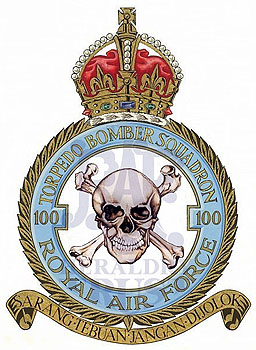
100 Squadron“The Boneyard”
“Sarang tebuan jangan dijolok”
Memorial Locations
Memorials (4)
Hatcliffe Top Lancaster Memorial
North Thoresby Lancaster Memorial
Plungar Lancaster Memorial
Waithe Lancaster Mid-Air Collision Memorial
Aircraft Types
Lancaster — Squadron code: HW-
Squadron History
No. 100 Squadron RAF was formed on 23 February 1917 at South Farnborough as the first night bomber squadron of the Royal Flying Corps, flying FE2b aircraft on the Western Front. The squadron served across eleven eras including WW1 bombing, inter-war training, torpedo operations from Singapore (1934-42), and the V-bomber nuclear deterrent force. In WW2, the squadron reformed as a Bomber Command unit on 15 December 1942 at RAF Waltham near Grimsby, flying Lancaster Mk IIIs. In 25 months of operations, 100 Squadron flew approximately 4,000 sorties on 280 raids, dropping 18,000 tons of bombs. 92 aircraft were lost on operations with a further 21 in crashes. 594 aircrew were killed. The squadron was distinguished by having four Lancasters that each completed over 100 operations — an extraordinary achievement when only 34 of the 7,000+ Lancasters built ever reached this milestone. 'Able Mabel' (ND458 HW-A) completed 132 operations, 'Phantom of the Ruhr' (EE139 HW-R) reached 121, 'Nan' (ND644 HW-N) flew 115 before being lost over Nuremberg, and 'Take it Easy' (JB603 HW-E) completed 111 before being lost over Hannover. Notable operations included the Battle of Berlin (308 sorties, 20 Lancasters lost, 115 killed), 'Black Thursday' on 16 December 1943 when fog at Waltham claimed four aircraft and 22 aircrew including the new CO Wing Commander Holford, the Dresden raid of 13/14 February 1945, and Operation Manna — food drops to the starving Dutch population. The squadron's final combat mission was the raid on Berchtesgaden on 25 April 1945. The squadron remains active today at RAF Leeming flying Hawk T1 aircraft.
Commanding Officers
Notable Personnel
Survived a collision with a night fighter over Stuttgart in February 1944 — the port wing was torn off. Somehow landed the Lancaster at Ford airfield. Awarded an immediate DFM. Tragically killed on a return sortie to Schweinfurt on 25 February 1944.
Flew Lancaster ND458 'Able Mabel' on her 100th operation to Chemnitz on 14/15 February 1945. Able Mabel went on to complete 132 operations — the highest of the squadron's four century Lancasters.
Shot down on 13 August 1944 over Bergentheim, Netherlands. Hidden by Dutch family Bote van der Wal. Both were captured and shot by the Gestapo. Two memorials in Bergentheim mark the spot, maintained and decorated with flowers by local Dutch villagers to this day.