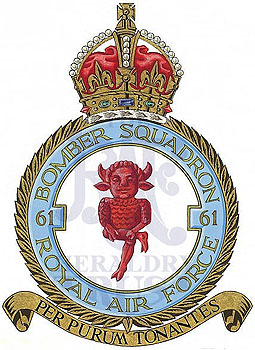
61 Squadron
Memorial Locations
Memorials (9)
61 Squadron Handley Page Hampden Crew
Avro Lancaster LM720
Bleasby (1) R.5703 Memorial
Bleasby (4) Lancaster Memorial
Cawston (1) P.4405 Memorial
Flying Fortress "Lucky Strike" Crew and Emergency Services
Handley Page Hampden P4399
Salthouse Lancaster Memorial
Staunton in the Vale W.4270 Memorial
Aircraft Types
Hampden, Lancaster, Lancaster R.5703, Hampden P.4405, B-17 Flying Fortress, Lancaster I W.4270 — Squadron code: QR-
Squadron History
No. 61 Squadron was formed at RAF Rochford, Essex, on 24 July 1917 as one of the first three single-seater fighter squadrons of the London Air Defence Area, equipped with Sopwith Pups to counter German daylight raids. On 12 August 1917, sixteen Pups intercepted a formation of Gotha bombers over the Thames estuary, turning them back — though not before bombs fell near the squadron's own hangars. Reformed on 8 March 1937 as a bomber squadron, 61 Squadron flew with No. 5 Group throughout WW2. Its first operational mission was an armed reconnaissance on Christmas Day 1939. The squadron took part in many of Bomber Command's landmark operations: the first raid on a German land target (Hörnum, March 1940), the first big raid on the German mainland (Mönchengladbach, May 1940), and the first bombing raid on Berlin (August 1940). Beginning with Hampdens, the squadron converted to Manchesters in 1941 and then Lancasters in spring 1942. Four of its Lancasters — ED860 'N-Nan', EE176, JB138, and LL843 — each completed over 100 operational sorties. During the Peenemünde raid on 3/4 November 1943, Flight Lieutenant William Reid of 61 Squadron won the Victoria Cross. In the summer of 1942, 61 Squadron was twice loaned to Coastal Command for anti-submarine operations in the Bay of Biscay. On 17 July 1942, a crew captained by Flight Lieutenant Casement became the first Bomber Command crew to bring back irrefutable evidence of destroying a U-boat at sea. The squadron's last wartime mission was on 25/26 April 1945 against Vallø, Norway. On 6 May 1945, its Lancasters ferried 336 ex-POWs home from Europe — a fitting final act. Post-war, the squadron flew Lincolns (including operations in Malaya and Kenya) and Canberras, disbanding on 31 March 1958.
Notable Personnel
Awarded for outstanding courage on the raid against Düsseldorf, 3/4 November 1943. Despite being wounded in the head and shoulders by a fighter attack that killed his navigator and disabled his aircraft's compass and communications, Reid pressed on to the target and bombed successfully before nursing his damaged Lancaster back to base.